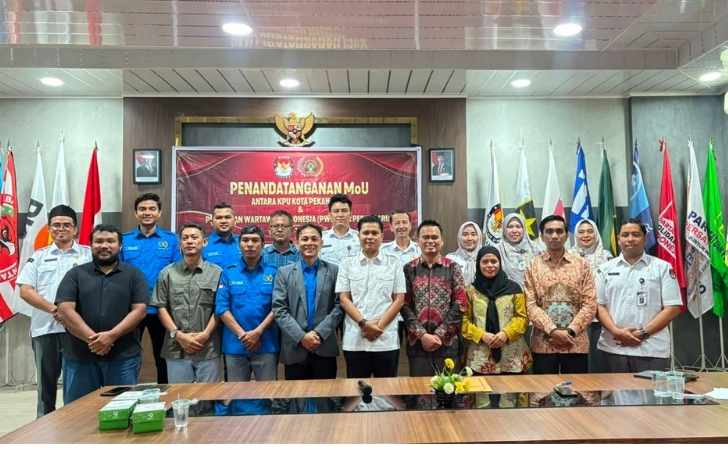
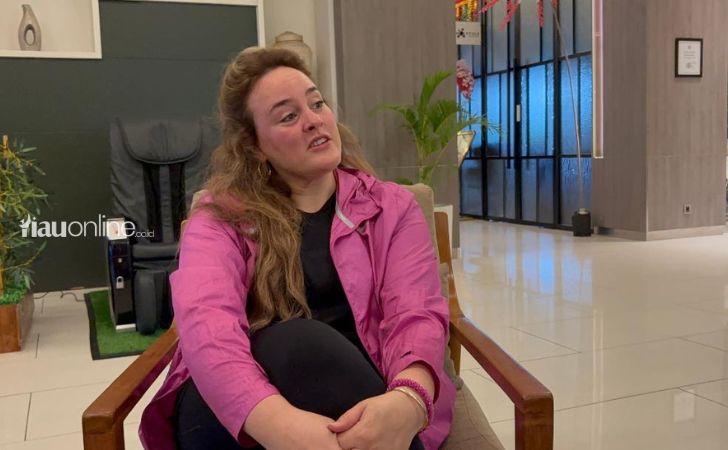
Frances Wijsman, cucu dari seorang tawanan perang dari Belanda, saat menceritakan tentang kakeknya. (RAHMADI DWI PUTRA/RIAU ONLINE)
Rabu, 3 September 2025 08:14 WIB
Penulis: Osvian Putra
RIAU ONLINE, PEKANBARU - “the terrible cruelty of the Japanese, the torture..”
Born in Pengkok, Gunung Kidul district, near Yogja. “I am about 86 years old.” He was a romusha working on the Sumatra railway, among other things afterwards, he became a farmer a farmer.
He inherited two parcels of lands: A rice field of more that half an acre and two and a half acres of lands in the mountains where he raises cassava, peanuts and soy beans. He has two to plow with.
‘the village council ordered me to become a romusha. The Japanese had ordered that every village should supply a numbers of romushas, who has to be young and healthy. There were 12 of us from my village, and from the surrounding villages an incredible number.
I was about 20 and it happened on a Friday, about four months after the bombardment on yogja, which I remember as if it were only yesterday. On that day it happened to be our turn. They’d called us together in the village hall, where right away he had to get into a truck that took us to yogja.
We barely has time to say goodbye. We didn’t know what kind of work we’d be doing or where. They gave us a check-up in yogja, and we got an injection to boost our strength. A week later they took us to Jakarta by train.
Baca Juga
I stayed there for seven months. He had to work on a railroad going to merak, on the western tip of java. My job was laying the rails. We worked from 7:00 till 12:00 o’clock, and from 1:00 till 4:00.
We were punished for everything we did wrong. The cruelties of the Japanese were without equal. They treated us like animals and beat us either with their bare hands or with a rubber truncheon, the kind the police have.
Following those seven months, they told me I had to go to pekanbaru. We crossed over from merak to bakauheni, sumatra’s southern tip, a two-hour trip by boat. From there they took us by truck to pekanbaru, which lasted a day and a half.
They did it in one haul, without stopping to eat. The open truck was crammed full and it was the dry monsoon: terribly to drink. A lot of people got unwell, they got headaches, and quite a few of them fainted. I did not my eyes, particularly because of hunger and thirst.
We got two days of rest in pekanbaru. They gave us some rice, which we had to cook ourselves. We drank the water without first boiling it. Sure, that made your belly rumble- but what do you expect, water that wasn’t boiled! Even so, most of us got better soon enough.
Then they put us to work, and the misery is impossible to describe. Three fellow villagers of mine died there, they were working on a bridge somewhere in the jungle. Two of them had to carry rails. The one in front slippers and the rail fell on top of them both.
The third, who was busy sawing nearby, also was struck by the rail. Because I was working close by, I saw the whole thing happen in front of my own eyes. I also buried them afterwards
Whoever was sick was taken to the hospital, but that was exactly the place where people died. I, too, was sick a lot, just like everybody else. I started to vomit blood. I was thinking: is this my fate then? But that’s when I gathered myself and went into the forest to look for healing herbs, particularly leaves from the jambu tree.
You has to eat those leaves the way a got does: you don’t pick them first but eat them straight off the tree. That’s how I got better. I had remembered this from my native region: if you have that sickness, you’ve got to eat bitter leaves straight from the tree. Don’t ask me why.
I saw a lot of people die. They died of a combination of things: they were beaten severely
Sumber: Henk Hovinga; The Sumatra Railroad: Final Destination Pakan Baroe